



You've been handed the assignment: some version of: "Put together our long-term vision for AI agents."
And there's so much noise. Which model is best this week. What your competitors are claiming. Whether humans are even still relevant. How are you supposed to work out what's affordable, what's buildable with the team you already have, and what actually fits your business model — while the ground keeps shifting under your feet?
I'll tell you how I do it, which I mostly learned from Rhythm Systems — an incredible company who you should definitely call if you're ever trying to firm up your strategy, align your entire exec team and organization to it, and knock your goals out of the park quarter after quarter.
I just use Claude Sonnet for this exercise currently (we're not doing any rocket science here), but use whatever AI model you prefer. Fill in the [COMPANY] and [DATE] placeholders with your own data.
Prompt 1: Reconnaissance
Research [COMPANY] as of [DATE]. I'm building a long-term AI agent product vision and need to size up the company first. Answer five questions, citing sources and flagging anything you couldn't verify:
Funding position — who owns or funds them, and what does that structure imply about appetite for long-horizon bets? Estimate the investors' likely exit window.Business model — how do they make money, precisely? Pricing, secondary revenue lines, customer count.Scale — headcount, trajectory, recent executive hires or departures.AI maturity — what have they actually shipped, native versus vendor-supplied? Do they employ ML engineers? What have direct competitors shipped?Strategic moves — M&A, platform plays, ambitions stated on the record.
Keep it under 600 words.
The output from this prompt will help ensure that your vision is fundable and buildable. Doing unglamorous homework before having opinions is the difference between a junior employee and a senior one.
Prompt 2: Read the weather
From that research, derive the 4–6 constraints that should dictate any AI agent strategy for [COMPANY]. For each: the fact, then the strategic implication in one line. Cover at minimum — the investor clock, the AI capability gap (build versus buy posture), the revenue shape (which metrics an agent must move to matter at all), the proprietary data asset, and the competitive window.
Every project has constraints. Your company has no ML engineers? Your vision should not include training and deploying AI models this quarter. The difference between a junior employee and a senior one is knowing to identify the constraint and name the mitigation: Milestone 1 might be to partner with a model provider, and hire or upskill one employee to own the unit economics of that partnership.
Prompt 3: Draw the mountain
Build a summit map:
The summit, 7–10 years out. One audacious, measurable end state. Big enough to organize a decade, concrete enough to be proven wrong.Three basecamps, working backward, 2–3 years apart. Each gets a name, a window, a one-line thesis, and an explicit link to the investor clock: which basecamp pays the current investors, and which ones are the acquirer's or next round's upside story.A "required to reach" list per basecamp — what must be shipped, hired, built, priced, and measured.
Route everything around the constraints. If a basecamp violates one, flag it. Don't smooth it over.
I use the @mirohq MCP to draw, but you can use Excalidraw or whatever you like. The important part here is "Don't smooth it over." Junior work hides tension to make the deck flow. Principal work diplomatically puts the tension on the slide — these are actual decisions to be made, and ignoring them will be the death of your plan.
Prompt 4: One click down — operations and cost
For each basecamp, specify agent-operations guidance across six dimensions: runtime placement, agent identity and licensing, cost economics (model cascading, prompt caching, unit-economics rules), security and data flow, measurement, and change management.
Name the two dimensions that are primary at each altitude. Estimate annual cost as a range and flag every assumption. Then state which cost-discipline decisions must be architected early because they cannot be retrofitted at scale.
This starts to turn the vision into a plan. Anyone can say "AI agents." Saying "roughly $2–4M a year by 2030, and here's the decision we have to make in Q1 or the margins never work" is what gets you in the room where budgets happen — a room you definitely want to be in if you desire authority over the work. The outputs here are just suggestions, but they will provide the shape of the decisions you're being asked to make. Just go ahead and get them on a page, and you can massage them from here.
Prompt 5: The picture
Create a minimalist flat-design vector illustration for a strategy slide (16:9). A single stylized mountain in your brand color, built from layered silhouettes. Three flat ledges on the ascending face, connected by a thin dashed accent-color trail to a small flag at the summit. Generous negative space above and beside the mountain for text overlay. Absolutely no text, letters, numbers, or labels anywhere in the image.
Ban text explicitly, in those words. Image models will cheerfully invent labels that say things like "BASECAMP TWO." Annoying. You layer the real ones on your the deck.
The output
I'm obsessed with this Rhythm Systems-style mountain graphic method for communicating high level strategy and how we'll get there, in a way that feels challenging yet achievable. Look at the density of information you get in one slide.
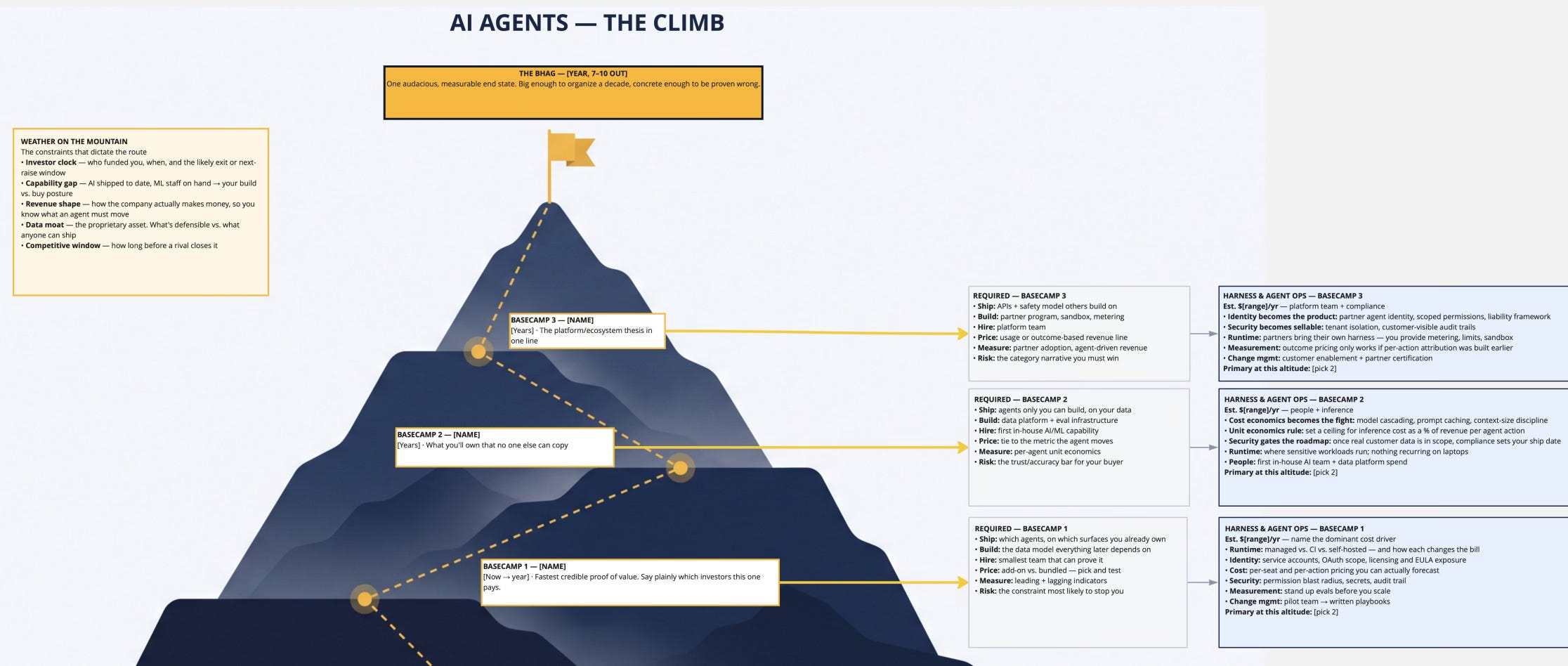
This first draft is never the final draft, but it takes under an hour to build, helps me organize the problem, surface challenges in bite-sized chunks, and reveals things that maybe I hadn't thought of yet. I love getting things out of my head and into Miro where I can collaborate on them with lots of stakeholders and advisors before finalizing our vision.
If this was helpful to you, let me know what improvements you end up making to the process. We're all learning together, no gatekeeping.