

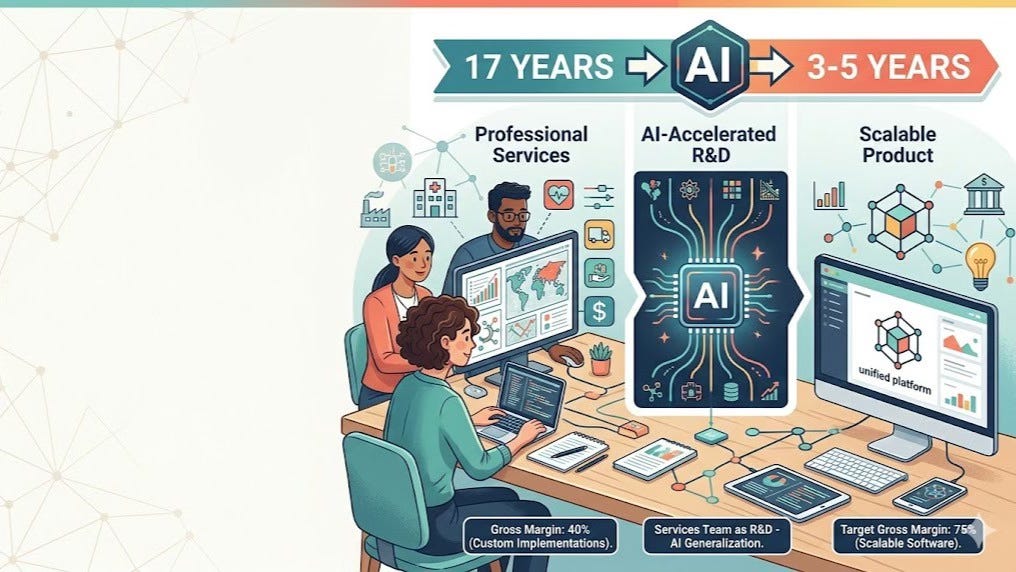
There's a fascinating business model emerging right now that doesn't quite have a clean name yet. For now, let's call it "Professional Services to Product."
The classic template here is Palantir. The playbook looks like this:
Go incredibly deep into a specific vertical.
Do the hard, hands-on implementation work that most software companies aren't ready to tackle themselves.
Let early customers help fund the discovery of what the final product actually needs to be.
Generalize those hard-earned learnings into scalable software.
While that journey took Palantir 17 years, AI is compressing that timeline down to just 3–5 years.
How to Spot This Model in the Wild
High-touch onboarding: The best customers can't quite use the product without the team's help yet (and that's a feature, not a bug!).
Services = R&D: The "services" or "implementation" team is functioning as the actual R&D engine.
Evolving margins: Gross margins might sit at 40-50% today, but every implementation makes the next one faster and more efficient.
Repetition before scale: The team is building the same custom solutions repeatedly until they understand the problem well enough to generalize it.
Relationship-driven retention: Retention is exceptionally high despite early product maturity because the team's dedicated support is doing the heavy lifting.
Hybrid roles: Job descriptions beautifully blend engineering with customer-facing work.
Consultative demos: The product demo feels a bit more like a consulting pitch than a standard software walkthrough.
Why Confusing This with Traditional SaaS Can Be Tricky
SaaS investors typically underwrite 70%+ gross margins, compounding net revenue retention, and hyper-efficient customer acquisition. But in year one of a "Services to Product" model, those metrics just aren't reality yet. If a deal is priced on SaaS multiples too early, the math gets tough the moment you hire your next implementation engineer.
The trap for founders: Raising traditional SaaS money and feeling pressured to skip the crucial deployment phase. It's tempting to hire product managers to build a generalized platform immediately, but jumping the gun rarely works out.
You can't abstract what you haven't learned yet. It takes time and deep, hands-on work to set a product team up for success.
The Takeaway
This is a highly fundable, scalable, and exciting model! It simply needs capital that understands and underwrites the trajectory—moving from 40% margins today to 75% in year four—rather than capital that expects you to already be at the finish line.
Eventually, this category will get its own dedicated investors. Until then: if your services team is your product team right now, you might be building something far more durable than a traditional consulting firm, and much more defensible than standard SaaS.
Definitely worth understanding before signing that term sheet!